Last week, we talked about why an internship should not be a student’s first introduction to a career.
Career development starts much earlier.
Before experience comes exploration.
Before exploration comes exposure.
And before a student can pursue an opportunity, they first have to know that opportunity exists.
So during National Career Development Month, Aequo Pathway Foundation is putting that idea into practice.
We are starting with something students encounter every day:
the subjects they learn in school.
And first up is math.
“When Am I Ever Going to Use This?”
It may be one of the most familiar questions in a math classroom.
And honestly, it is a fair question.
For students, math can sometimes feel like worksheets, formulas, equations, and problems that seem disconnected from anything outside of school.
But in the working world, math rarely announces itself as “math.”
It looks like figuring out how much water a firefighter needs to safely attack a fire.
It looks like making sure a building is constructed at the correct angle.
It looks like calculating a medication dose, forecasting how much inventory a company will need, analyzing an athlete’s performance, estimating the cost of a construction project, or determining whether a business is actually making money.
The math is still there.
The context has changed.
And sometimes context is what helps a student see a subject differently.
What Does Math Look Like on the Job?
A recent Education Week feature on Cass Career Center in Missouri offered some particularly vivid examples.
Fire-science students there learn to work with whole-number and decimal operations, unit conversions, ratios, rates, and formulas as they calculate water flow, friction loss, and pump-discharge pressure.
Those calculations are not simply exercises.
Too much water, the wrong hose, or an incorrect pressure calculation can create real consequences when fighting a fire.
Construction students at the school use the Pythagorean theorem to ensure they are building at the proper angles.
Health-services students apply geometry while learning the correct angle for inserting a needle during phlebotomy practice.
The lesson is not that every student needs to become a firefighter, construction professional, or healthcare worker.
It is that the math students encounter in school does not disappear when they leave the classroom.
It becomes a tool.
Math Can Lead to More Places Than Students May Realize
Consider just a few examples.
Firefighter
Firefighters may use ratios, measurements, pressure calculations, flow rates, and unit conversions when operating equipment and determining how to safely move water through hoses.
Construction Manager
Construction professionals work with measurements, geometry, estimates, quantities, project costs, and budgets.
Data Analyst
Data analysts use statistics, percentages, patterns, and mathematical reasoning to understand information and help organizations make decisions.
Electrician
Electricians work with measurements, formulas, electrical loads, voltage, current, and other calculations needed to install and maintain safe systems.
Radiologic Technologist
Radiologic technologists rely on precise measurements and calculations related to imaging, positioning, and radiation exposure.
Supply Chain Analyst
Supply chain professionals use forecasting, inventory calculations, demand data, and statistical analysis to help products move efficiently from one place to another.
And that is only the beginning.
Math also shows up in architecture, aviation, sports, finance, manufacturing, entrepreneurship, healthcare, engineering, skilled trades, logistics, technology, and countless other fields.
A student does not have to dream of becoming a mathematician for math to become part of their future.
Sometimes Students Need Context Before Confidence
There is another reason these connections matter.
A student may decide very early:
“I’m not a math person.”
Sometimes that conclusion comes from difficulty with the subject.
Sometimes it comes from one bad experience.
Sometimes students simply have not seen math used in a way that connects to something they care about.
Career exploration does not replace good math instruction.
But it can give learning context.
A student who loves construction might suddenly understand why geometry matters.
A student interested in sports might become curious about statistics.
A future entrepreneur may begin seeing percentages differently when they represent pricing, profit margins, or growth.
A student fascinated by healthcare may discover that math plays an important role in patient care.
The subject has not changed.
What has changed is the student’s understanding of where it can lead.
This Is What Early Exposure Can Look Like
Career exposure does not always need to begin with a formal internship, job shadow, or career decision.
Sometimes it begins with something much smaller.
A student learns that firefighters use math.
They meet a firefighter or fire-science professional and ask questions.
Later, they participate in a related class, camp, career program, or hands-on experience.
Years later, when an internship, apprenticeship, certification program, or job opportunity appears, that field is no longer completely unfamiliar.
That is the progression:
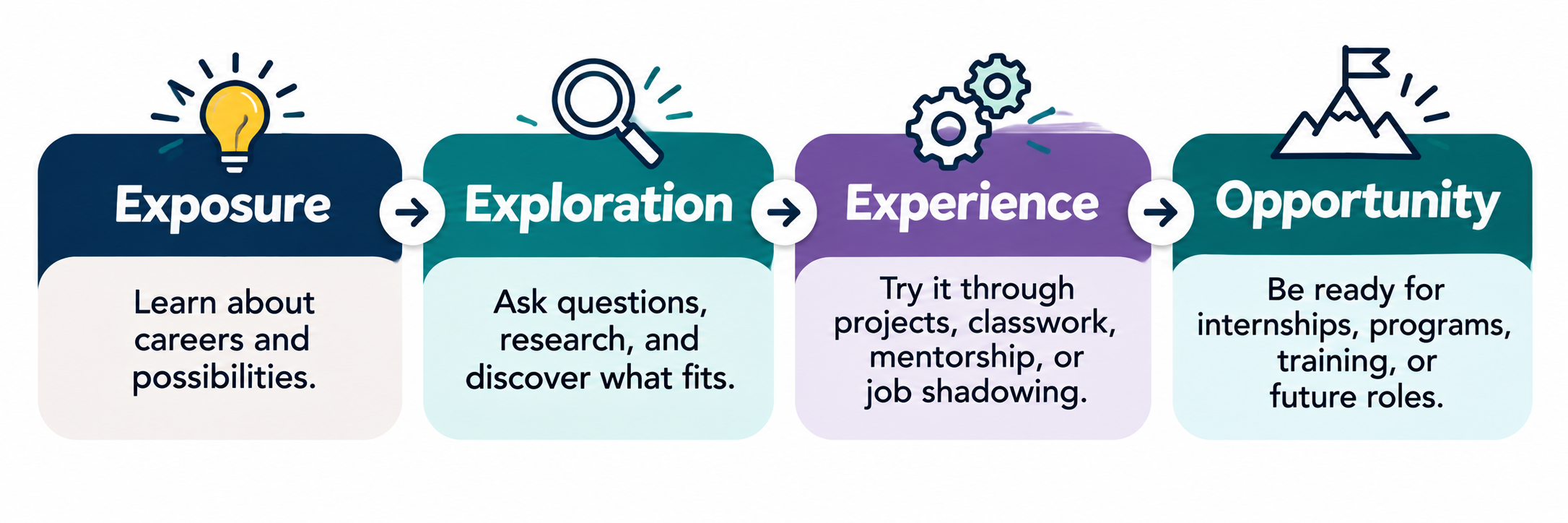
Exposure → Exploration → Experience → Opportunity
Not every student will travel all the way through that progression for every career they encounter.
They should not.
Exploration also helps students discover what they do not want to pursue.
The value is in giving them enough exposure to make those discoveries for themselves.
Pearson Career Ready describes middle-school career exploration as an opportunity to widen students’ options, identify what sparks their interest, and connect natural aptitudes with potential careers.
The same report notes that middle school is a period when students are beginning to recognize what they enjoy, what they do not enjoy, and what naturally draws their curiosity.
That makes these years an ideal time to start opening doors—not closing them.
Students Don’t Need to Choose. They Need to See.
A middle school student does not need to decide today whether they want to become a firefighter, electrician, radiologic technologist, data analyst, entrepreneur, or construction manager.
They may ultimately choose none of those things.
But they should have the opportunity to learn that those possibilities exist.
That is what early career exposure can do.
It gives students context before they need to make choices.
It helps them connect what they are learning now with things they might do later.
And it gives them more possibilities to explore before the stakes become higher.
At Aequo Pathway Foundation, that is the idea behind our work.
We are not asking students to choose their future.
We want to help them see more of it.
So throughout National Career Development Month, we will continue asking:
Where can this subject take you?
This week, the answer starts with math.
And the possibilities go much farther than “mathematician.”
One subject. More possibilities than you think.
References
Pearson Career Ready. Career Awareness and Exploration in Middle School: Helping Students Discover Who They Are and Where They’re Going. The report discusses the role of middle-school career exploration in widening students’ awareness of career options, connecting interests and aptitudes to careers, and integrating career exploration into classroom learning.
Langreo, Lauraine. “The CTE Program Answering the Question ‘Why Do I Need Math to Be a Firefighter?’” Education Week, October 22, 2026. The article profiles Cass Career Center’s integrated academic model and examples of students applying mathematics in fire science, construction, healthcare, and other career programs.
